Greenwich Palace
The Constant PrincessGreenwich Palace becomes a place where royal status is both enacted and privately endured. Within its walls Catalina of Aragon marries Henry VIII in a restrained ceremony, and later enters rooms prepared for what she believes will be the birth of a child. The same palace that witnesses her arrival as queen thus frames a painful reversal: after months of expectation and confinement, she returns to her ordinary rooms without a baby or the public ceremonies that should have followed a birth.
Marriage within the palace
On 11 June 1509, Catalina and Henry marry in the church of the Friars Observant within Greenwich Palace. The small service contrasts with her earlier wedding to Arthur, which had taken place in St Paul’s Cathedral amid ambassadors and public celebration. At Greenwich there are only three witnesses and a handful of people present. There is no lavish feast, music, dancing, or public bedding; the couple dine before the court and then withdraw together. The understated ceremony reflects Catalina’s dread of repeating vows once spoken to Arthur, even as she carries out Arthur’s stated wish that she marry Henry.
The palace’s rooms also register a change in Catalina’s standing. Margaret Beaufort, Henry’s grandmother, is present at the wedding, but Catalina notes that there is no proposal to place her under Margaret’s supervision. Instead, Margaret has moved out of her rooms for the new queen. Catalina treats the arrangement as a measure of how far her position has shifted: she is now Queen of England, not a dependent widow whose place at court can be directed by her husband’s grandmother. The palace is therefore not merely a venue for the marriage; its allocation of rooms makes the altered household hierarchy visible.
Rooms prepared for an heir
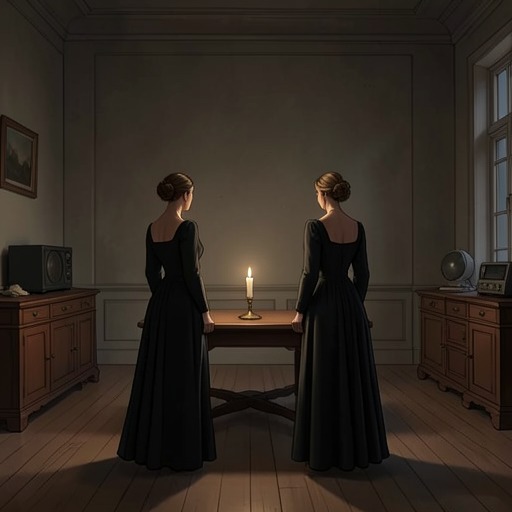
In 1510, Greenwich Palace is prepared for Catalina’s expected confinement. The arrangements follow the instructions in the Royal Book attributed to the king’s mother: the rooms are hung with tapestries showing encouraging scenes, carpeted with rugs, and strewn with fresh herbs. Catalina pauses at the doorway before entering, while her friends raise glasses of spiced wine behind her. She understands the confinement as her great work for England and as the fulfillment of her dynastic purpose. Once the door closes, she expects not to see her friends again until the child is born.
The women who accompany her give the prepared rooms a domestic as well as ceremonial character. Elizabeth Boleyn places a pomander beside Catalina’s bed; Lady Elizabeth and Lady Anne, sisters of the Duke of Buckingham, adjust a tapestry; María de Salinas stands near the newly prepared bed; and Margaret Pole arranges the cradle. Catalina asks Margaret Pole to take charge of the royal nurseries, seeking the counsel of an older woman who is herself a mother. The scene gathers the practical work of birth around the expectation of a future royal child, although that anticipated future will not arrive.
Confinement without a birth
By May, Catalina has to send for Henry to tell him difficult news. He is reluctant to enter the room because it has been prepared for a confinement, and she also notices his lack of warmth toward her. Margaret Beaufort closes the door behind them to prevent anyone outside from overhearing. The setting makes the news intimate and guarded: the room designed for a public dynastic outcome becomes the place where Catalina first tells her husband that the expectation will not be fulfilled.
Catalina eventually leaves confinement without announcement and returns to her usual rooms at Greenwich Palace. There is no churching ceremony to mark a return to ordinary life, because no birth has taken place, and no christening, because there is no child. The court behaves as though her absence lasted hours rather than nearly three months. Her return does not immediately restore clarity: she notices her ladies exchanging glances and falling silent, initially supposing their unease concerns misconduct during her absence, before recognizing that something more serious has happened and that no one is telling her.
The palace as a dynastic setting
Greenwich Palace’s significance lies in the contrast between its public forms and hidden outcomes. The wedding is deliberately quiet but establishes Catalina as queen; the later confinement is meticulously prepared but ends without the child on whom dynastic hopes depend. In both episodes, rooms and ceremonies position her body within the political life of the court, while her private feelings remain largely concealed from it. The palace’s repeated use links marriage, queenship, and the expectation of an heir, then exposes the distance between the elaborate arrangements surrounding those expectations and the uncertain, solitary experience of their failure.